
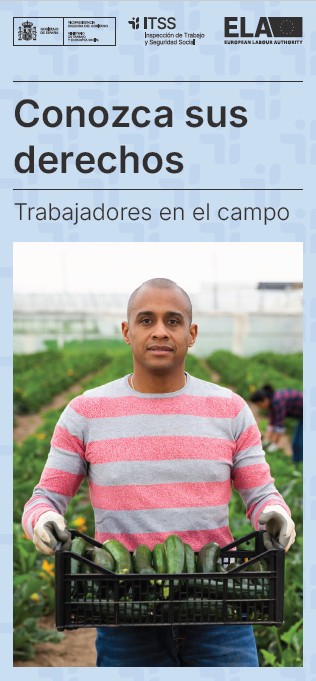
KNOW YOUR RIGHTS
Farm workers

Right to a fair wage
• You have the right to receive the salary established in the collective agreement that is applicable and, in case no agreement is applied to you, the interprofessional minimum wage (SMI).
The SMI in 2026 is 57.82 € per day or 1.221 € per month.
• In addition, you have the right to perceive Two extraordinary payments per year of at least €1,221, each:
• Extraordinary payments are received at Christmas and in another month that is agreed (usually June or July).
• It can be agreed in a collective agreement that the two extraordinary payments are received on another date, for example, each month along with your salary:
If you are going to receive both payments each month along with your monthly salary, you would be entitled to receive at least 1.424.50€ per month for 12 months (which is the sum of 1.221 € + 203.50 € of proportional part of the two extraordinary payments).
• Temporary and temporary workers (hiring in the same company for less than 120 days), who charge per working day and receive their salary in a global way (including the proportional part of Sundays, holidays and extraordinary payments), have the right to receive 57.82 euros per working day.
• If you perform overtime, the entrepreneur must pay them in money or compensate them with paid breaks.
• Deductions. The company must retain only the amounts set forth in the Law. In particular:
• The part of the Social Security contribution corresponding to the worker:
• 6.58% if the contract is indefinite
• 6.53% if the contract is temporary
• Withholding Personal Income Tax (if applicable).
Right to a limited time
• You have the right to have the day agreed in the collective agreements or work contract fulfilled.
• The maximum duration of the ordinary working day is forty hours a week of effective work of average in annual computation. If you do more hours, they will be overtime.
• When seasonal circumstances determine the need to intensify the work the day can be extended up to a maximum of twenty hours per week, without the daily working day being able to exceed twelve hours of effective work.
• Working time limitations in particularly harsh conditions
To protect the health of agricultural workers, the law sets limits on the length of the day when tasks involve great physical effort or especially harsh conditions. It will be the collective agreements that determine which tasks are included in these categories:
• Work with physical effort or painful conditions: When the work requires an extraordinary effort or is carried out under abnormal conditions of temperature or humidity, the day cannot exceed:
6 hours and 20 minutes daily
🗓 38 hours a week of effective work.
• Works with feet in water or mud/Cavas open: The day may not exceed:
6 hours a day
🗓 36 hours a week of effective work.
Right to holidays
You have the right to 30 natural days of vacation per year remunerated (equivalent to 22 working days). If you work less than one year, you are entitled to the proportional share.
Right to weekly rest
• You have the right to a minimum weekly rest Uninterrupted day and a half that, as a general rule, will be the afternoon of Saturday or, where appropriate, the morning of Monday and the full day of Sunday.
• The company can accumulate this rest in periods of fourteen days (or even longer, depending on the type of activity and as established in the collective agreement).
The right not to be discriminated against and to be treated with dignity
• Your company is prohibited from treating you badly or differently for any reason (sex, race, ethnicity, religion…)
• Your employer may not treat women differently or take any action against them because they are pregnant or breastfeeding.
• You have the right to respect for your privacy and due consideration for your dignity, including protection from harassment.
The right to effective health and safety protection at work, the right to work in a safe and healthy place
• Training: You have the right to receive clear and understandable information and training on:
• The dangers of the work you do.
• Preventive measures to avoid accidents or diseases.
• The health and safety standards applicable to your position.
The training must be adapted to your language, level of understanding and way of learning, so that you can work safely.
• Protective equipment: In agricultural work, the use of personal protective equipment is especially important because of the risks arising from outdoor work or in greenhouses, the use of heavy machinery, contact with animals, chemicals, biological agents, etc.
• The company is obliged to provide you free the necessary protective equipment (clothing, gloves, helmet, glasses, masks, footwear, etc. ).
• For your part, you should use it correctly and keep it in good condition.
• Accommodation: If you are entitled to accommodation, because this is stipulated in your contract or collective agreement, the latter must comply with health and safety regulations, ensuring:
• Decent living conditions (rest, hygiene, food).
• Clean, ventilated and safe spaces.
• Access to water, electricity, toilets and showers.
• Separate use of facilities for men and women, where applicable.
• Weather conditions: Working outdoors can expose you to adverse environmental conditions due to extreme temperatures, rain or wind, which can cause you to heat shock, dehydration, hypothermia, skin cancer, etc. The entrepreneur must prevent exposure to these weather conditions from posing a risk to his/her health, providing free of charge the means to guarantee his/her protection:
• Clothing suitable to the weather.
• Sun protection.
• Drinking water.
Likewise, there is a ban on performing certain tasks during the hours of the day in which adverse weather events occur, in those cases in which due protection cannot be guaranteed otherwise.
In cases of orange or red level warnings due to adverse weather events, the company is obliged to adapt its working conditions, including reducing or modifying the hours of its development.
Rights in the event of an accident at work or occupational disease
In the event of an accident at work or occupational disease, you have the right to:
• Immediate medical assistance.
• Economic Benefit for as long as you are incapacitated.
If you believe that the accident or illness has occurred because the company has breached its obligations, you can file an accident. complaint to the Labour Inspectorate.
Social Security Rights
They are basic obligations of the company:
• Request the worker’s discharge from Social Security before he or she begins work.
• Contribute to Social Security for all the hours worked and for all the remuneration paid to it.
If the company fails to comply with these obligations, it will not be able to access Social Security benefits, or it will receive them to a lesser extent than it would be entitled to.
Foreign people who are not nationals of a country of the European Union can only work, be registered and contribute to Social Security if they have authorization to work in Spain.
What to do in case of violation of these rights?
If you believe that your rights have been violated, you can file a complaint with the Labour and Social Security Inspectorate.
You can find information on how to file a complaint on our website:
The Labour and Social Security Inspectorate will consider the origin of the complaint to be confidential.
In the event that you have been working in Spain for a minimum period of six months in the last two years, you can collaborate with the Labour and Social Security Inspectorate by filing a complaint about these facts which, if proven, will allow you to initiate the procedures for granting you the temporary residence permit due to exceptional circumstances of collaboration with authorities, reasons of national security or public interest. This authorization will enable you to work legally in Spain.
KNOW YOUR RIGHTS
FOR MORE INFORMATION VISIT THESE WEBSITES
• Labour and Social Security Inspectorate
• About working conditions in Spain
• If you work in the Basque Country, you can also visit this website: Labour Inspection - Labour Inspection - Labour and Employment - Basque Government - euskadi.eus
• If you work in Catalonia, you can also visit this website: He inspected from Treball. Treball