
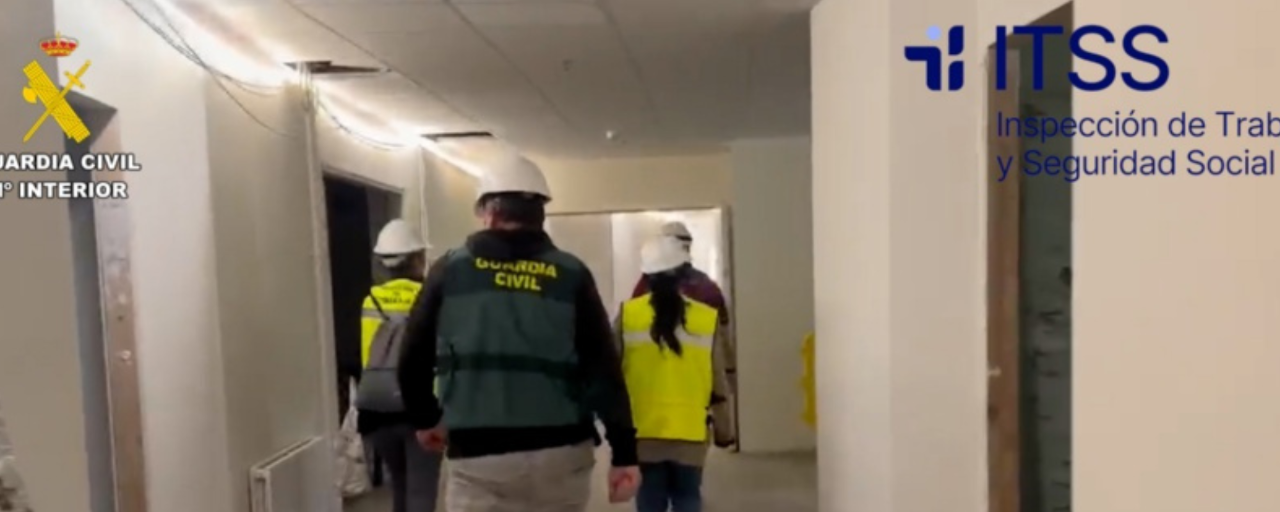
The Civil Guard has arrested three people who formed a labor exploitation network dedicated to providing cheap labor in buildings in the north of the country. Hay at least 41 identified victims, foreign workers in a vulnerable situation, who worked in Cantabria, Asturias and the Basque Country.
Last summer, the Judicial Police of the Civil Guard detected signs of this possible network and the exploitation of many workers at work, pointing to possible crimes related to the promotion of social security. illegal immigration, human trafficking, against the rights of workers and the rights of foreign citizens, among others.
The agents carried out surveillance and numerous checks in Cantabria, Basque Country and Asturias. They managed to identify a company whose principal manager was operating in Bizkaia and whose economic headquarters was in Vitoria-Gasteiz.
They discovered that many of the workers were in one situation of special vulnerability due to economic or social circumstances which favoured a state of dependency on those who controlled their movements and working conditions.
During the proceedings, it was observed that many of the workers were initially reluctant to cooperate with the authorities, making it difficult to verify their identity and administrative situation, due in part to the control exercised over them by their recruiters and the fact of their irregular situation. Subsequently, several of them acknowledged having paid significant amounts of money to organizations dedicated to facilitating irregular immigration to reach Spain and access to employment.
Many of these workers had made long and complex journeys to our country through different routes and means of transport, coming in many cases to incur significant debts to finance the trip.
The research focused mainly on Álava, Bizkaia, Cantabria and Asturias. The agents detected that, at the beginning of each working day, numerous workers concentrated in different points of Vitoria-Gasteiz, from where they were distributed in vehicles to different construction works, reaching hundreds of kilometers daily.
In the cases of Asturias and Cantabria, due to the distance from the headquarters of the company investigated, the workers were housed in homes where they remained during the working week in conditions that are being investigated.
In view of the indications detected, and in accordance with the existing agreement between the State Secretariat for Security and the State Agency for Labour and Social Security Inspection, In February 2026, the Labour and Social Security Inspectorate joined the investigation..
During the development of the research several were known accidents at work Suffered by workers linked to the investigated network. At least two of them were said to have been taken to health centres for medical assistance and subsequently taken out of work.
The investigations allowed us to gather solid indications of the existence of a organised structure allegedly dedicated to promoting irregular immigration and exploiting vulnerable foreign workers in the labour marketin addition to being related to other criminal offences.
Therefore, last May of 2026, the Labour and Social Security Inspectorate and the Organic Judicial Police Units of the Civil Guard of Álava and Cantabria, with the support of more than seventy personnel of the USECIC of the Basque Country, Cantabria and Asturias, carried out a simultaneous operation in several works in northern Spain.
As a result of the performance, one was inspected Ten works located in Cantabria, Basque Country and Asturias, with alleged labour irregularities detected in seven of them.
During the operation they were identified 41 foreign workers Linked to different investigated companies, most of them using third-party documentation to prove their identity and being in an irregular administrative situation (40 of the 41 workers).
The proceedings have been placed at the disposal of the competent judicial authority of Santander, which is currently conducting the investigation of the proceedings.
In total, Three people have been arrested, business leaders. A fourth is also investigated for her involvement in the events. The operation, by name “Ambotan-Canapu”, remains open and new actions are not ruled out as the analysis of the documentation and devices intervened progresses.